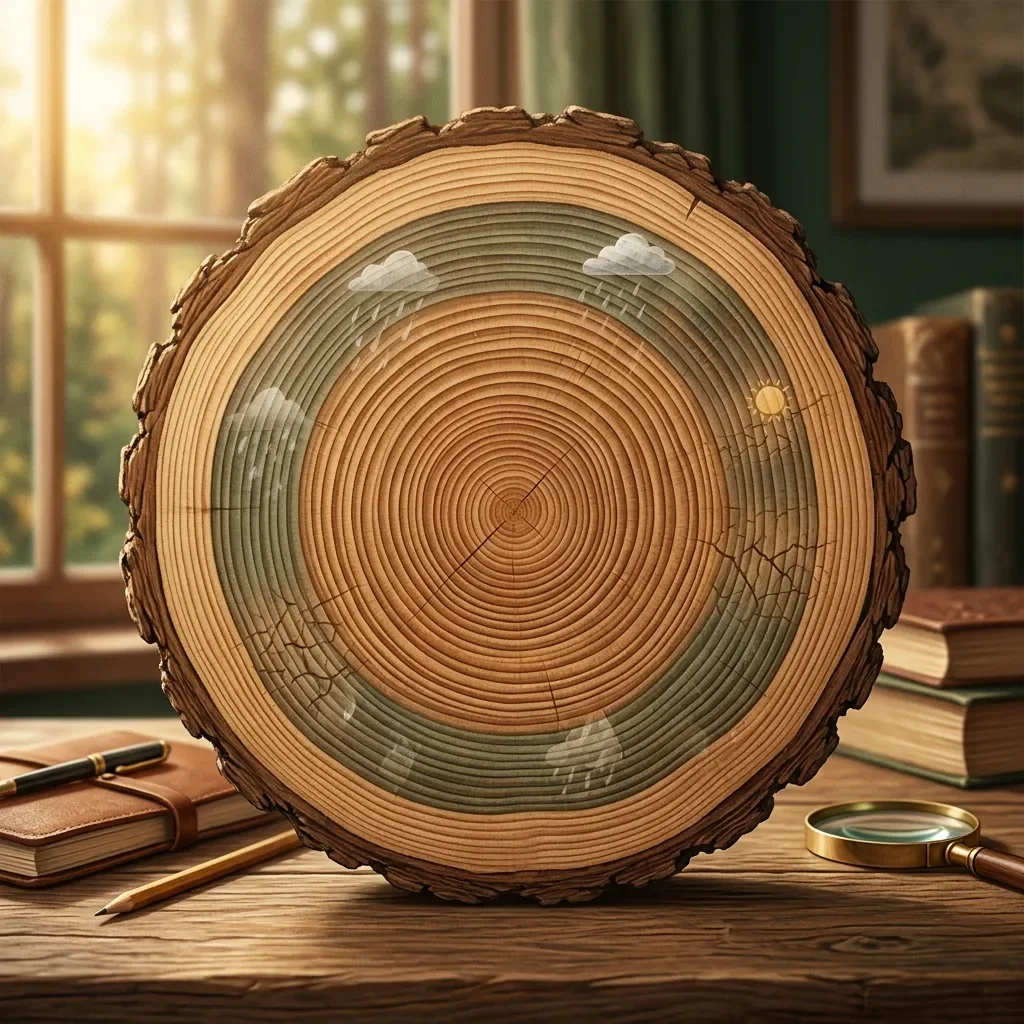
Listening practice: The rings that remember rain1×0:007:110:00Part one: full English listening2:36Part two: Chinese explanation and vocabulary4:36Part three: English replay0:00主播Imagine holding a pencil-thin piece of wood taken from the side of an old tree. It looks quiet at first: pale lines, dark lines, one ring beside another. But according to NOAA's Climate.gov, those rings can carry a weather history from the place where the tree grew. In a dry region, a wider ring often points to a wetter growing season, while a narrow ring can point to stress from limited water. A ring is not a diary with words, so scientists have to be careful. They do not read one tree like a fortune-teller reads a hand. They compare many trees from the same area, looking for a shared pattern of thick and thin rings.0:35主播This science is called dendrochronology. The National Park Service explains that researchers can remove a thin core with an increment borer, a tool with a small cutting tube, without cutting the tree down. The core shows the tree's annual growth pattern. If the pattern in one piece of wood overlaps with the pattern in another, researchers can connect the two timelines. That is why tree rings can help date old buildings, ancient wooden beams, and historic settlements. The same method can link living trees with dead wood that has been preserved for centuries. A living tree may cover a few hundred years, but preserved wood can extend the record farther back.1:14主播NOAA's National Centers for Environmental Information manages the International Tree-Ring Data Bank, the world's largest public archive of tree ring data. NOAA says the archive includes ring width, wood density, isotope measurements, and site chronologies from more than five thousand sites on six continents. These records matter because modern weather stations only cover a short slice of human history. If scientists want to know whether a recent drought is unusual, they need more than one lifetime of measurements. Tree rings can push climate clues back hundreds or even thousands of years, giving scientists a longer baseline for drought, temperature, and natural climate variability.1:55主播NASA's Earth Observatory tells the story through ancient bristlecone pines in the mountains of California. In such dry places, water can strongly control growth, so annual rings may record changes in rainfall. NOAA's drought variability pages also explain how drought atlases use tree-ring information to reconstruct wet and dry conditions before modern monitoring. These maps are not made from a single tree or a single guess. They come from many dated samples, compared with modern weather records where the two overlap. The point is simple but powerful: a tree does not write sentences, yet its body can keep a year-by-year record. When scientists line up many records carefully, a forest becomes a climate archive.2:36讲解这一期的主线很清楚:树木年轮不只告诉我们树的年龄,还能记录它生长那一年附近的天气条件。请注意,英文里没有把一棵树当成绝对证据,而是反复强调 scientists compare many trees,也就是科学家会比较同一区域的许多树,寻找共同的宽窄模式。3:02讲解先抓几个关键词。tree ring,是树木年轮。dendrochronology,是树轮年代学,dendro 跟树有关,chronology 跟时间顺序有关。increment borer,是取树芯的小工具。tree core,就是从树干里取出的细长样本。wide ring 和 narrow ring 分别是宽年轮和窄年轮,常常对应较好或较差的生长条件。3:33讲解再听几个重点短语。weather history,天气历史,不是天气预报。shared pattern,共同模式,指多棵树出现相似的年轮变化。preserved wood,保存下来的木材,比如古建筑里的木梁。public archive,公共档案库。baseline,基准线,用来和现在的气候变化进行比较。4:02讲解最后看一个长句的主干:When scientists line up many records carefully, a forest becomes a climate archive. 先听从句 When scientists line up many records carefully,意思是当科学家仔细排列许多记录;主句是 a forest becomes a climate archive,一片森林就成了气候档案。第二遍英文重播时,请重点听 NOAA, NASA, tree rings, drought, archive 这些词。4:36主播Imagine holding a pencil-thin piece of wood taken from the side of an old tree. It looks quiet at first: pale lines, dark lines, one ring beside another. But according to NOAA's Climate.gov, those rings can carry a weather history from the place where the tree grew. In a dry region, a wider ring often points to a wetter growing season, while a narrow ring can point to stress from limited water. A ring is not a diary with words, so scientists have to be careful. They do not read one tree like a fortune-teller reads a hand. They compare many trees from the same area, looking for a shared pattern of thick and thin rings.5:13主播This science is called dendrochronology. The National Park Service explains that researchers can remove a thin core with an increment borer, a tool with a small cutting tube, without cutting the tree down. The core shows the tree's annual growth pattern. If the pattern in one piece of wood overlaps with the pattern in another, researchers can connect the two timelines. That is why tree rings can help date old buildings, ancient wooden beams, and historic settlements. The same method can link living trees with dead wood that has been preserved for centuries. A living tree may cover a few hundred years, but preserved wood can extend the record farther back.5:50主播NOAA's National Centers for Environmental Information manages the International Tree-Ring Data Bank, the world's largest public archive of tree ring data. NOAA says the archive includes ring width, wood density, isotope measurements, and site chronologies from more than five thousand sites on six continents. These records matter because modern weather stations only cover a short slice of human history. If scientists want to know whether a recent drought is unusual, they need more than one lifetime of measurements. Tree rings can push climate clues back hundreds or even thousands of years, giving scientists a longer baseline for drought, temperature, and natural climate variability.6:30主播NASA's Earth Observatory tells the story through ancient bristlecone pines in the mountains of California. In such dry places, water can strongly control growth, so annual rings may record changes in rainfall. NOAA's drought variability pages also explain how drought atlases use tree-ring information to reconstruct wet and dry conditions before modern monitoring. These maps are not made from a single tree or a single guess. They come from many dated samples, compared with modern weather records where the two overlap. The point is simple but powerful: a tree does not write sentences, yet its body can keep a year-by-year record. When scientists line up many records carefully, a forest becomes a climate archive.

Add more perspectives or context around this Post.